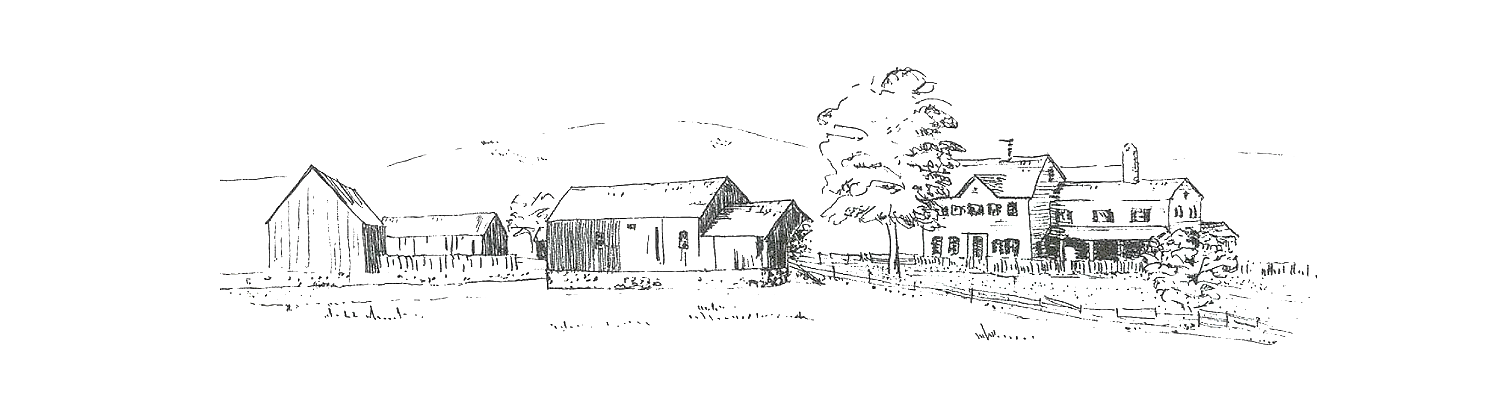
History of Center School House

Center School on Center Hill Road in Barkhamsted is one of the few remaining examples of what was once a standard landmark feature of every New England community: the one room schoolhouse. Its history can be traced back to the beginnings of the 19th century, and it stands today as reminder of the progress that has been made in the process of public education.
Center School in District #1 evolved from earlier buildings dating back to the beginning of the 19th century. As with many ancient buildings, it has changed and evolved over the years. The first Center School was a two-story building on the Green in the old center of Town, (“The Hollow”) probably built around 1821. As with most school buildings of that time, it was poorly maintained, and by the 1870s was in desperate need of repair. In view of the greatly reduced population, the old building was reduced in size to one story and moved a short distance to a new site Here it remained as a public school until 1936. By that time, the one room schools were being eliminated in favor of a Consolidated School in Pleasant Valley. The old schoolhouse was sold to Metropolitan District Commission to be used as a storage facility.
In 1980 the old schoolhouse was acquired by the Barkhamsted Historical Society and moved from its original location to a new site of Center Hill Road. Since that time efforts have been to restore the building and turn it into an education museum. The Barkhamsted Historical Society is working to preserve this important slice of our history and to provide future generations with a view of what school would have been like in the early years of our community. Our efforts to identify and share information about the early schools are an on-going project. We welcome new information and would appreciate an opportunity to copy any old photographs and/or documents that relate to education in Barkhamsted. We can be contacted at bhs@barkhamstedhistory.us.
Education in Early Barkhamsted
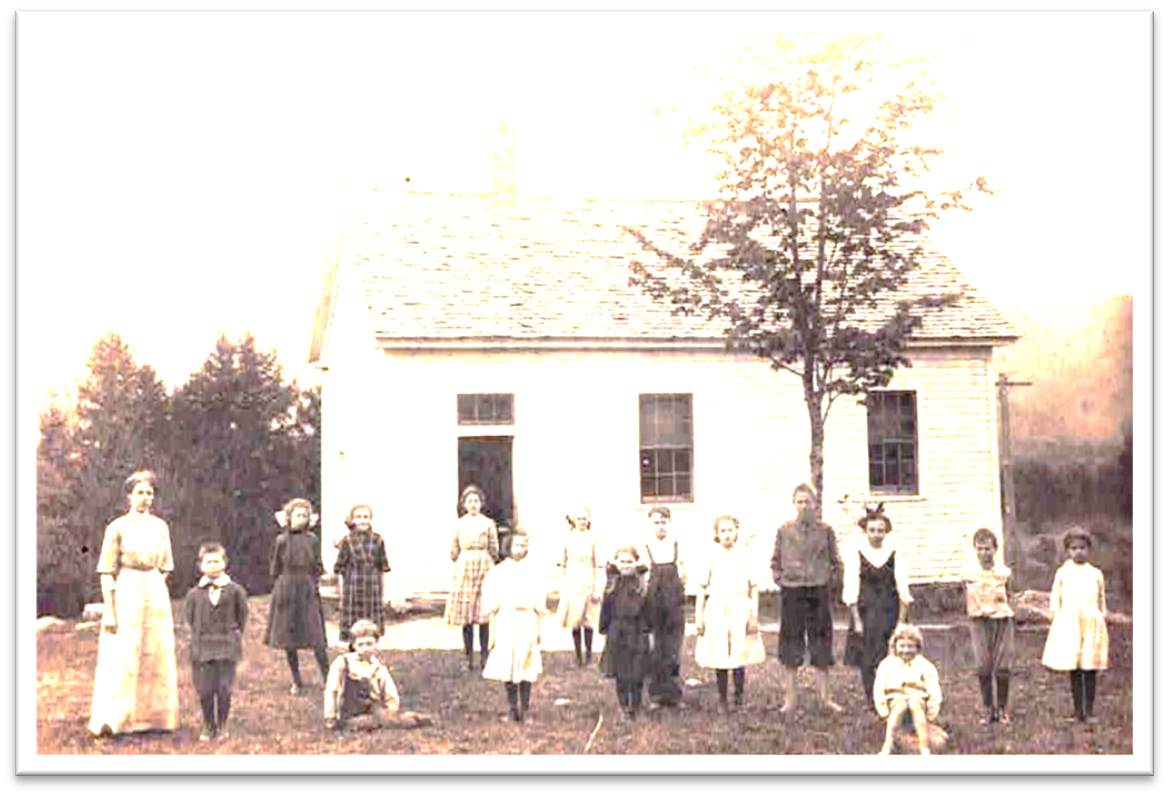
Miss Church and the class assembled for a photograph outside Center School 1912.
Until well into the 20th century, the children of Barkhamsted attended a number of one room schoolhouses in neighborhood school districts scattered throughout the town. The number of school districts varied greatly over the years with the fluctuations in population. In the 1840s we had six districts; in the 1850s we had twelve; in the 1880s we had eleven, and in the 1940s we had two. Decisions were made on a yearly basis as to whether to authorize a class in a particular school district or, in the interests of economy, to combine two nearby districts in one building. Children in the border districts were often sent to school in the neighboring towns, with Barkhamsted paying tuition. Children in surrounding towns sometimes attended Barkhamsted schools with those towns paying tuition here. Schools were also held in private homes or in vacant structures, as well as in specific school buildings. Each district managed its own affairs, hired its own teachers and maintained its own records. A town-wide board called the School Visitors exercised a minimal level of supervision over the districts, as well as allocated a small amount of State funds to them.
The population of Barkhamsted in the 1870s was about 1,300 people and there were about 250 children registered in a dozen schools. Why were there so many schools? Everyone had to walk to school. There were no school buses, no sidewalks to walk on, and the roads were not plowed. In winter the kids - even the youngest ones - had to trudge through the snow. There’s a limit to how far even tough farm kids can be asked to walk in bad weather, and in the 19th century that distance was about a mile and a half. So, schools had to be placed so that the kids could walk to them, and this led to the establishment of a number of small schools fairly evenly spread around the town. As the population changed and shifted, districts were added or closed, as were the school buildings. Generally speaking, each district would have a single one room school, but some districts with relatively large populations, such as Riverton and Pleasant Valley, might have a two-room school. In urban areas such as downtown Winsted or Torrington, there might be a school with several rooms, each housing a different grade level, but here in the country, the one room school was the standard well into the 1930s.
The manner in which schools operated has also changed over the years. In the 1870s a school year in Barkhamsted was 134 days; one of the shortest in the state. The State average was 176 days. In 1880 the Connecticut State legislature passed a law requiring that schools be in session for at least thirty-six weeks in each calendar year. But that didn't necessarily mean that students attended school for 180 days. Another law passed that same year made parents responsible for seeing that their children attended school for at least 60 days in twelve consecutive months. A third law required that when children under the age of fourteen were employed outside the home, the parents were to provide the employer with a certificate, signed by the teacher, testifying that the child had indeed attended school for the minimum amount of time as required by the law. It may be noted that prior to 1880 quite a few schools around the state, and most of the schools in Fairfield Country, had a 200 day school year.
Until the 1880s, schools usually had two distinct sessions, a winter school of twelve to fourteen weeks that began after Thanksgiving that was usually taught by a man; and a summer school that ran from May through September that was taught by a woman. While children could attend either or both sessions, the winter session was usually dominated by boys and older students, while the summer session focused more on the girls and the younger students. This two track system was driven by the fact that in the summer time, the boys and older girls were needed to help with the farm work. They couldn’t be spared to waste time on things like reading and writing. The younger kids on the other hand, would go to school during the summer, partially for education, and partially as a form of community day care. In the late fall, after the harvest was in, more of those older children could be spared to go to school. But at the same time, it would be harder for the girls and the little children to get to school because of the weather. The tradition of separate winter and summer sessions lasted for much of the 19th century, dying out sooner in the cities and later in the rural communities.
For much of the nineteenth century teaching was not so much a profession as a part-time job that just about anyone could do until something better came along. No specific training was required to be a teacher, but the candidate had to be interviewed and approved by the Board of School Visitors, a small group appointed by the town to supervise the schools. If the candidate was approved, a license such as the one shown below was written out, and the teacher hired for that term. Employment was for one term at a time with no guarantee of renewal; salaries were very low and working conditions were awful. Teachers were often teenagers with no formal training. The best that could be hoped for was a college student earning money for his tuition. As late as 1893 the official town report on Barkhamsted’s schools was mentioning the poor preparation that teachers brought to the post: "Six of the list of teachers never before had taught. They were comparatively school girls, until recently attending the same or similar district schools, stepping from the district scholar's bench to the district teacher's chair with little or not any special training for the position. That, under the circumstances, they had so fair success is more surprising than if they had met with flat failure."
Towards the end of the nineteenth century, many communities around the state began to look towards eliminating the independent local districts and moving towards a single town-wide organization. Such a reorganization would allow for the elimination of the one room schoolhouses and the creation of larger “consolidated” schools that organized their students into grades. This idea came to Barkhamsted in 1898 when the Annual Town Meeting considered “whether the Town will abolish all the school districts … and assume and maintain control of the Public Schools therein.” The vote was 35 in favor, but 107 against, a clear message that the local school districts still had considerable support. But change was in the wind, and in 1909 the State mandated that the town governments assume control of the local schools. The tiny local schools would remain open for a few more years but under more centralized control.
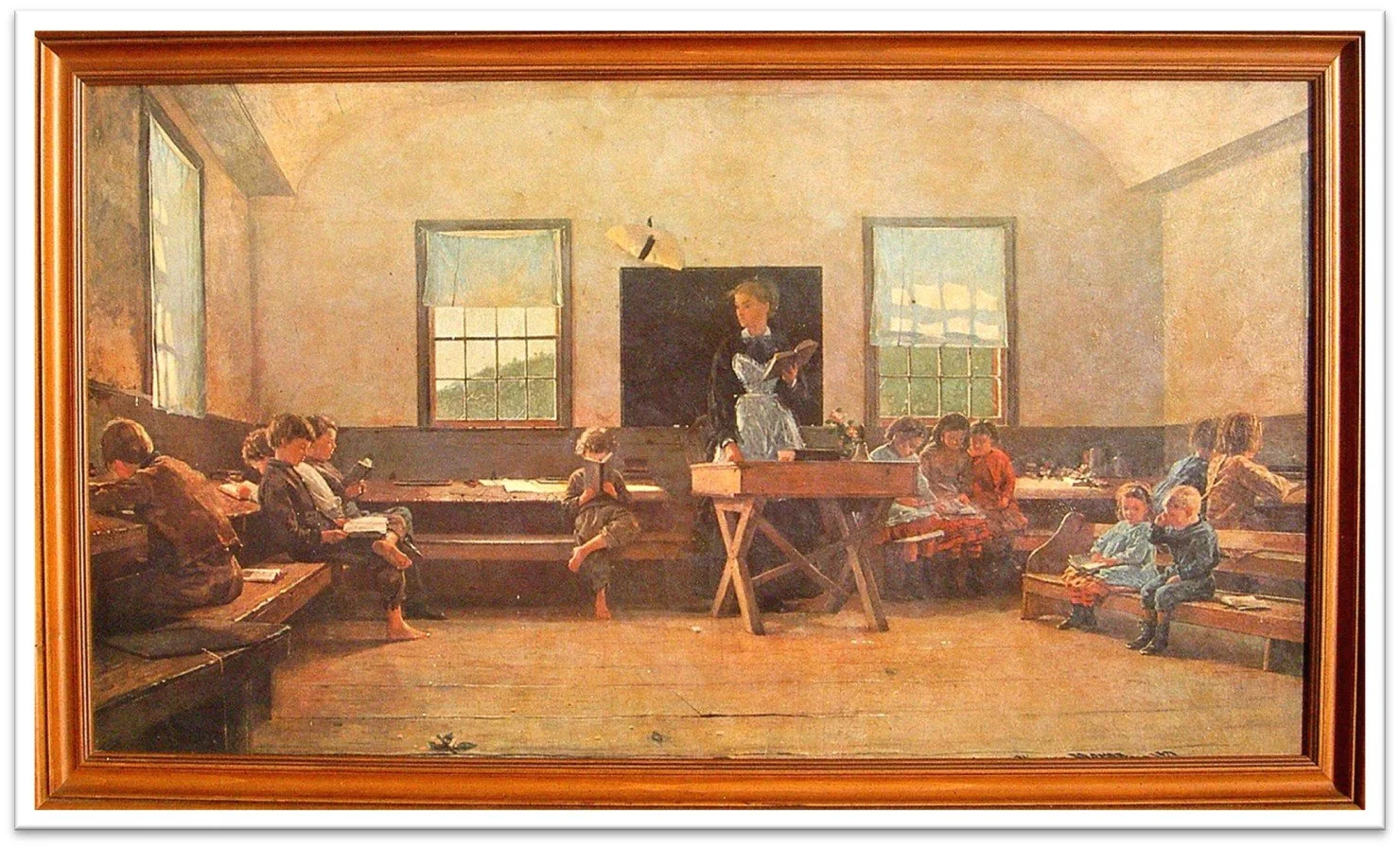
The painting by Winslow Homer called “New England Country School” gives us a good view of what a class in Center School would have looked like in the 1870s. The physical structure shown here is very close to what we have in our school: the curved ceiling, the two windows with a blackboard in the middle.
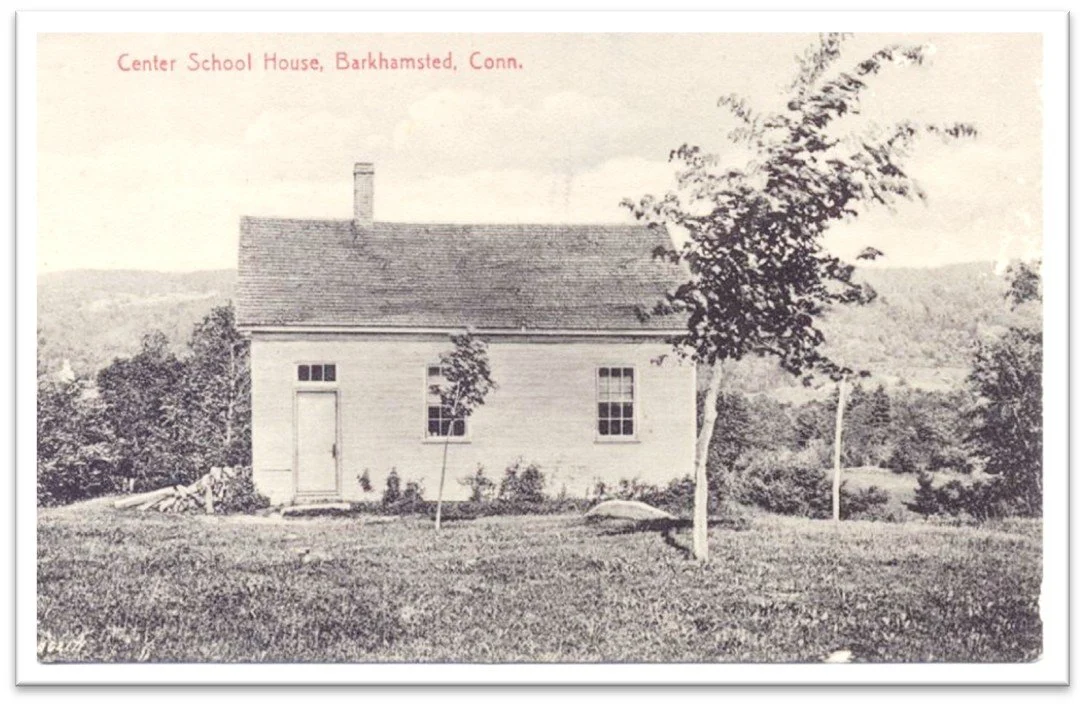
Center School in 1910. Note the firewood piled at the left side of the building.
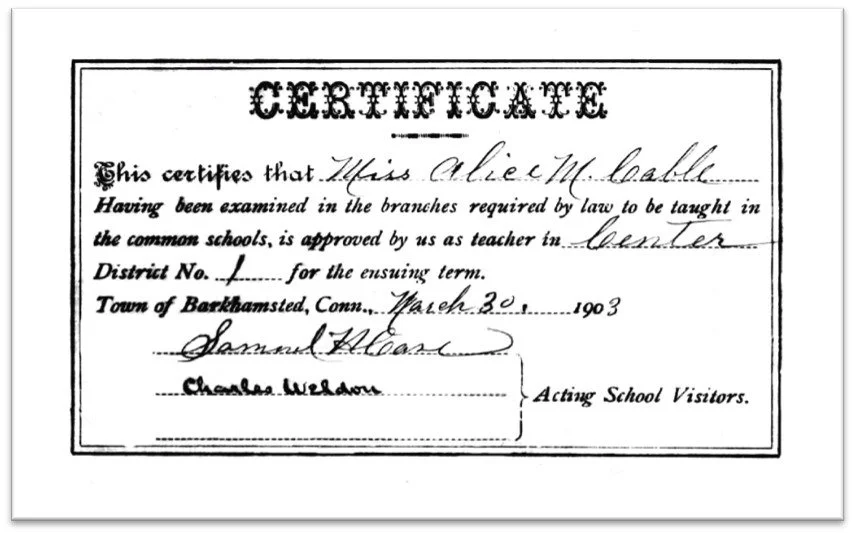
Certificate authorizing Miss Alice Cable to teach in Center School in 1903.
In the early years of the 19th century, country schools were furnished with home-made benches. Schools began replacing those homemade benches with factory made “combination desks” in the 1860s . These had a folding seat in front attached to a desk in back and were designed to be fastened to the floor. They came in a variety of heights, some as single units such as the one shown here, others as double units that allowed two students to sit side-by-side. Notice the elaborate iron work on the sides which usually includes the manufacturers name and a patent date. Center School has a number of different desks made at various times from the 1870s through the 1920s, reflecting the fact that our school was used over a long period of time.
The earliest schools were heated by open fireplaces. Students near the fireplace would be uncomfortably hot while those at the far corners of the room would find their ink freezing in the bottle. Gradually there was a change to the safer and more efficient enclosed stove, but a good wood supply was still needed. Parents were expected to provide wood for the school in proportion to the number of students they sent. This was often a contentious issue with some parents forgetting to deliver their allotment on time, and other sending wood of such poor quality that it was close to useless. It was not unusual for a school to be closed for the day due to a lack of firewood. School committees often appointed a specific person to measure and officially accept the firewood to be sure it was up to standard. The wood was usually delivered in “sled lengths” and was often left in the snow outside the schoolhouse door. Look closely at the picture of Center School in 1910 (below) and notice the wood pile at the left side of the building. A common complaint in early days regarding school facilities was that there was no woodshed or any way to protect the firewood supply. When wood was needed to keep the stove going, some of the older boys would be assigned to dig the wood out of the snow, and to saw the logs into “stove lengths,” so a firewood saw would be a standard piece of school equipment. It was also traditional that the older students would take turns going to school early in the morning to start the fire, so the building would be warm when the teacher and the rest of the students arrived. That’s probably why so many of the old school buildings burned down.
In October of 1909, the Barkhamsted School Committee voted, “to petition the State Board of Education to appoint a Supervisor for our schools.” The supervisor provided by the State was William H. Bliss and he must have had his hands full. “On my first visit I placed in the hands of each teacher a copy of the State Suggestive Course of Study. Teachers were early furnished a program setting forth in detail the order of exercises, and they were required to make preparations for the daily work.” By the end of the year, he could report that, “Much progress was noted in most of the schools. Nearly all concerned have worked with a willingness and an evident desire to accomplish something. Teachers’ meetings were held for the purpose of giving instruction in methods of teaching and school management.”
In 1937 Center School finally closed and the last six students transferred to the larger, newer school in Pleasant Valley. Other small schools soon closed and by 1938/39 the town had just two school districts – Riverton and Pleasant Valley – each with a two room school. In the 1940s and 1950s the Pleasant Valley School was gradually expanded and in time became Barkhamsted Elementary School. The era of the one room school-house had ended.
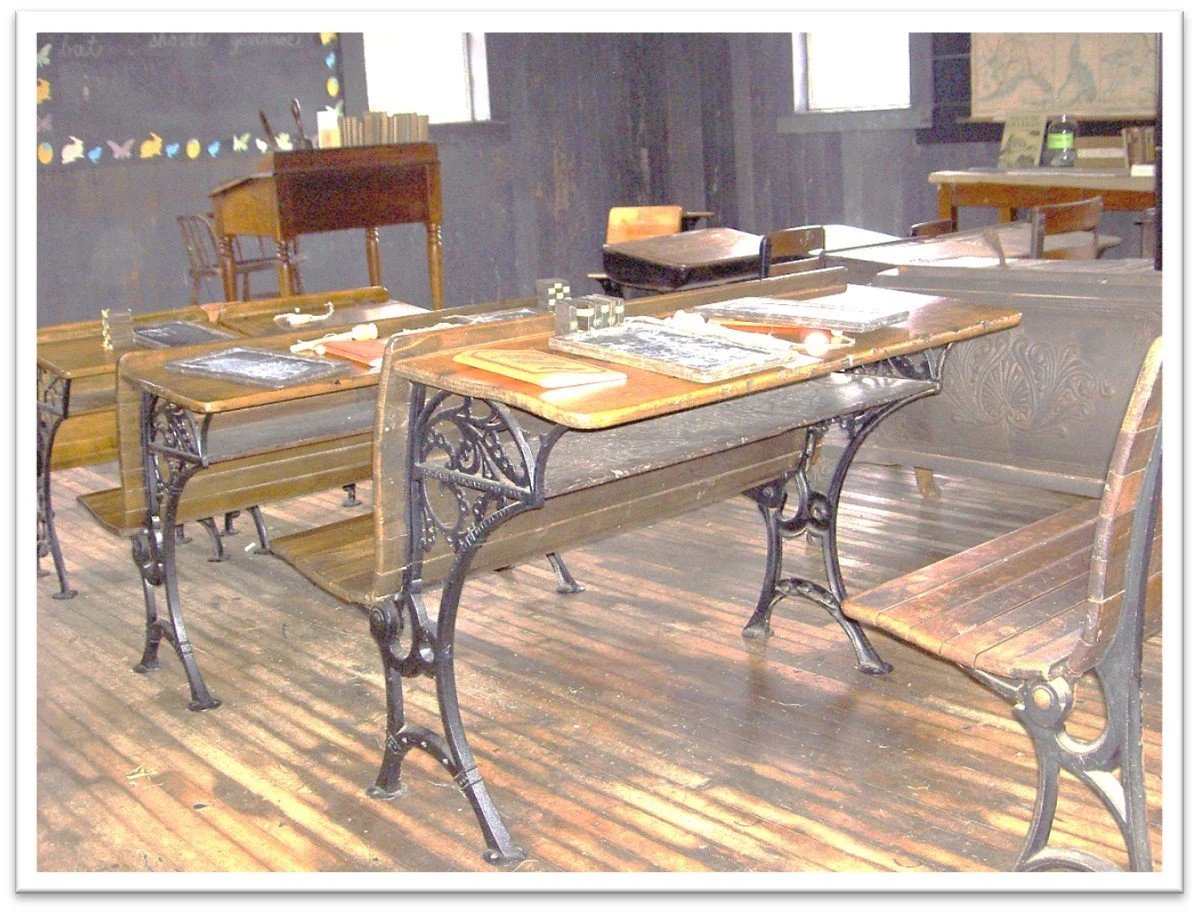
Inside the School House
The “combination desks” used in the 1860s
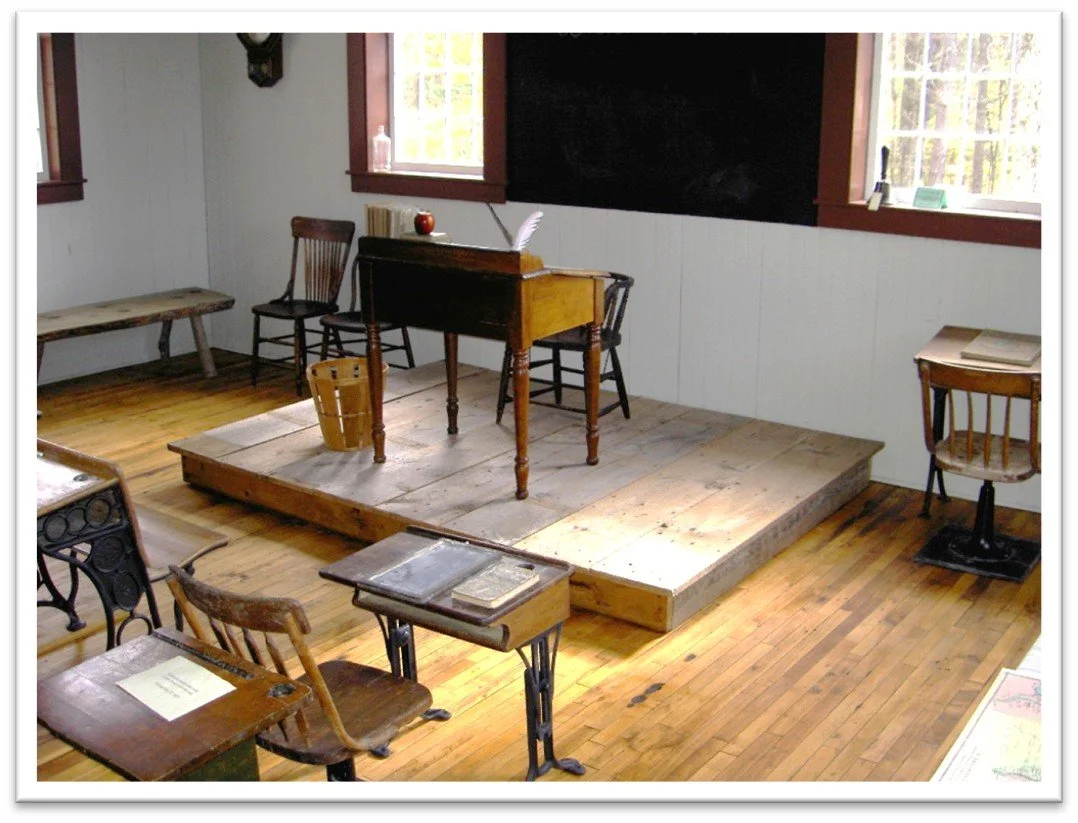
The teacher’s desk was traditionally raised on a small platform at the front of the room. The blackboard behind it consists of wooden boards painted black. It was here that individual instruction took place.